
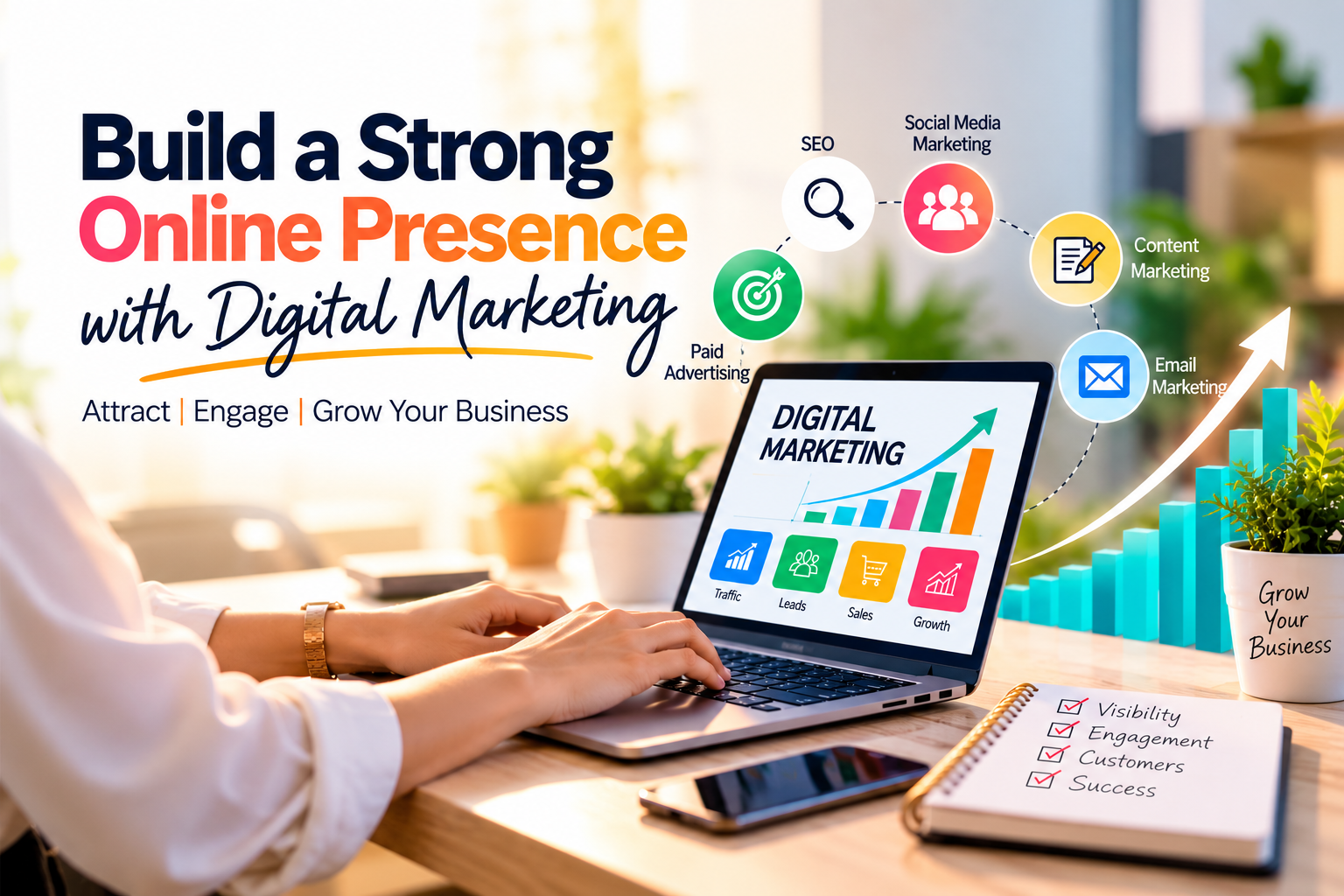
Build a Strong Online Presence: A Guide for Businesses
Today, customers spend a large part of their time online. They search for businesses on Google, check social media profiles, read reviews, and visit websites before making a decision.
Therefore, having an online presence is no longer optional for most businesses. If customers cannot find your business online, they may choose a competitor instead.
The good news is that you can build a strong online presence with the right strategy. You do not need to be everywhere at once. Instead, you need to understand your audience, choose the right digital channels, and provide useful information consistently.
In this guide, we will explain how to create a strong online presence and how digital marketing can help your business grow.
What Does an Online Presence Mean?
Your online presence is everything people can find about your business on the internet.
This includes your:
- Website
- Google Business Profile
- Social media accounts
- Blog posts
- Online reviews
- Business listings
- Videos
- Search engine results
- Online advertisements
For example, when someone searches for your business on Google, they may see your website, social media pages, reviews, images, and business information.
Together, these elements create your online presence.
A professional and consistent presence can help people understand who you are, what you offer, and why they should choose your business.
Why Should You Build a Strong Online Presence?
Customers have changed the way they discover businesses.
In the past, people often relied on recommendations, newspapers, signs, or physical stores. Today, however, many customers begin their journey with an online search.
For example, a person looking for a digital marketing service may search for:
“digital marketing services near me”
They may then compare several businesses before contacting one.
As a result, your online visibility can influence whether a potential customer discovers your business or your competitor.
Here are some of the biggest reasons to build a strong online presence.
1. Increase Your Brand Visibility
First, a strong online presence makes your business easier to find.
Your website can appear in search results. Your social media content can reach new audiences. Your business profile can appear when people search locally.
Therefore, each digital channel creates another opportunity for customers to discover your brand.
The more useful and consistent your presence becomes, the easier it is for people to remember your business.
2. Build Trust With Potential Customers
People want to trust a business before they spend money with it.
Your online presence can help establish that trust.
For example, customers may look at your website, read reviews, check your social media activity, and explore your services before contacting you.
A professional website and consistent branding can create a positive first impression.
In addition, helpful blog posts can demonstrate your knowledge and experience.
Customer reviews can also provide social proof.
Therefore, your online presence should not only promote your business. It should also answer customer questions and reduce uncertainty.
3. Reach the Right Audience
Another important benefit is targeted reach.
Digital marketing allows businesses to connect with specific groups of people based on their interests, location, search behavior, and needs.
For example, a local business can focus on customers in its service area. Similarly, an online business can reach customers across different cities or countries.
This makes digital marketing more focused than simply advertising to a large audience.
As a result, you can spend more time and resources reaching people who are more likely to need your products or services.
4. Use SEO to Get Found on Google
Search Engine Optimization, or SEO, is one of the most important ways to build a strong online presence.
SEO helps your website appear when people search for information related to your business.
For example, a digital marketing business might create content around topics such as:
- Digital marketing for small businesses
- SEO for local businesses
- Social media marketing
- Online marketing strategies
- How to grow a business online
However, SEO is more than adding keywords to a page.
You also need useful content, clear headings, a good website experience, relevant links, and information that genuinely answers the searcher’s question.
Therefore, focus on helping the reader first.
When your content is useful, it has a better chance of attracting and retaining visitors.
5. Create Valuable Content
Content marketing is another effective way to strengthen your online presence.
Your content can include:
- Blog posts
- Videos
- Social media posts
- Guides
- Case studies
- FAQs
- Infographics
- Email newsletters
For example, if you provide digital marketing services, you could write a blog explaining how SEO can help a small business.
This type of content can attract people who are researching a problem that your business can solve.
Furthermore, useful content can help you establish authority in your industry.
Instead of simply telling people that you are an expert, you demonstrate your knowledge by helping them.
6. Use Social Media to Connect With Customers
Social media is an important part of a modern online presence.
However, you do not need to use every social media platform.
Instead, find out where your target audience spends time and focus your efforts there.
You can share:
- Educational tips
- Customer stories
- Short videos
- Business updates
- Behind-the-scenes content
- Industry news
- Helpful advice
- Product or service information
Most importantly, social media should be about more than selling.
People want useful and authentic content. Therefore, focus on creating conversations and building relationships.
Over time, this can help turn followers into customers.
8. Manage Your Online Reputation
Your reputation matters.
Before contacting a business, customers may search for reviews and feedback.
Therefore, pay attention to what people are saying about your business online.
Encourage satisfied customers to leave genuine reviews. At the same time, respond professionally to questions and negative feedback.
Do not ignore customer concerns.
Instead, use feedback as an opportunity to improve your service.
As your reputation improves, new customers may feel more confident about choosing your business.
9. Make Your Business Easy to Contact
A strong online presence should make it easy for customers to take the next step.
For example, your website could include:
- A contact form
- Phone number
- Email address
- WhatsApp button
- Booking option
- Social media links
- Clear calls to action
10. Keep Your Branding Consistent
Consistency helps people recognize your business.
Your website, social media profiles, graphics, and other digital channels should have a similar look and message.
For example, use consistent:
- Logo
- Brand colors
- Fonts
- Tone of voice
- Business description
- Contact information
As a result, customers can recognize your brand more easily across different platforms.
Consistency also makes your business look more professional.
11. Measure Your Online Performance
Building an online presence is not a one-time task.
You need to measure your results and improve your strategy.
For example, you can track:
- Website traffic
- Search traffic
- Leads
- Social media engagement
- Website conversions
- Popular blog posts
- Customer inquiries
- Advertising results
These numbers can show you what is working.
For example, if one blog post brings many visitors and inquiries, you can create more content around that topic.
Similarly, if a social media platform produces little engagement, you can review your strategy or focus on another channel.
Therefore, data can help you make smarter marketing decisions.
How to Build a Strong Online Presence Step by Step
Now that you understand why an online presence matters, let’s look at a simple process you can follow.
Step 1: Define Your Target Customer
First, identify who you want to reach.
Ask yourself:
- Who needs my product or service?
- What problem do they have?
- What questions do they ask?
- Where do they search for information?
- What makes them choose one business over another?
The clearer your audience is, the easier it becomes to create relevant content.
Step 2: Create or Improve Your Website
Next, make sure your website clearly explains your business.
Your homepage should tell visitors what you do, who you help, and how they can contact you.
Keep the design clean and the information easy to find.
Step 3: Research Relevant Keywords
Keyword research can help you understand what your audience searches for.
For example, tools such as Ahrefs can help you discover search terms related to your business.
However, do not choose keywords only because they have high search volume.
Look for keywords that are relevant to your services and realistic for your website to target.
Step 4: Create Helpful Content
Once you understand what your audience wants to know, create useful content around those topics.
Answer real questions.
Solve real problems.
Give practical advice.
As a result, your website can become a useful resource for potential customers.
Step 5: Build Your Social Media Presence
Choose the platforms that make sense for your audience.
Then create a realistic posting schedule.
You do not need to publish ten times every day.
Instead, focus on quality and consistency.
Step 6: Encourage Reviews
Ask happy customers to share honest feedback.
Positive reviews can help build trust. Moreover, reviews can give potential customers more confidence when comparing businesses.
Step 7: Keep Improving
Finally, review your results regularly.
Digital marketing changes quickly. Therefore, your strategy should evolve as your audience, competitors, and platforms change.
Common Mistakes to Avoid
Many businesses want to build a strong online presence, but they make a few common mistakes.
Trying to Be Everywhere
You do not need to use every social media platform.
Focus on the channels that matter most to your audience.
Posting Without a Strategy
Posting random content may not produce meaningful results.
Instead, create content around your business goals and customer needs.
Ignoring SEO
A beautiful website is useful. However, people still need to find it.
Therefore, include SEO in your long-term digital strategy.
Focusing Only on Selling
Constantly promoting your products can make your content feel repetitive.
Instead, educate, help, and engage your audience.
Sales can follow when you build trust.
Giving Up Too Early
Online growth takes time.
SEO, content marketing, and social media often require consistent effort.
Therefore, measure progress over time instead of expecting instant results.
Final Thoughts
To build a strong online presence, you need more than a website or a social media account.
You need a clear strategy.
Your website should explain your business. Your content should help your audience. Your SEO should make you easier to find. Your social media should build relationships. Finally, your digital marketing should guide people toward becoming customers.
Most importantly, remember that your online presence represents your business when you are not there to speak for yourself.
So, make it useful. Make it professional. Make it consistent.
At Go Digital by Rekha, we believe that every business deserves a clear and effective digital presence.
Ready to build your online presence and grow your business? Go digital with the right strategy.